8K home cinema and dedicated Hi-Fi audio
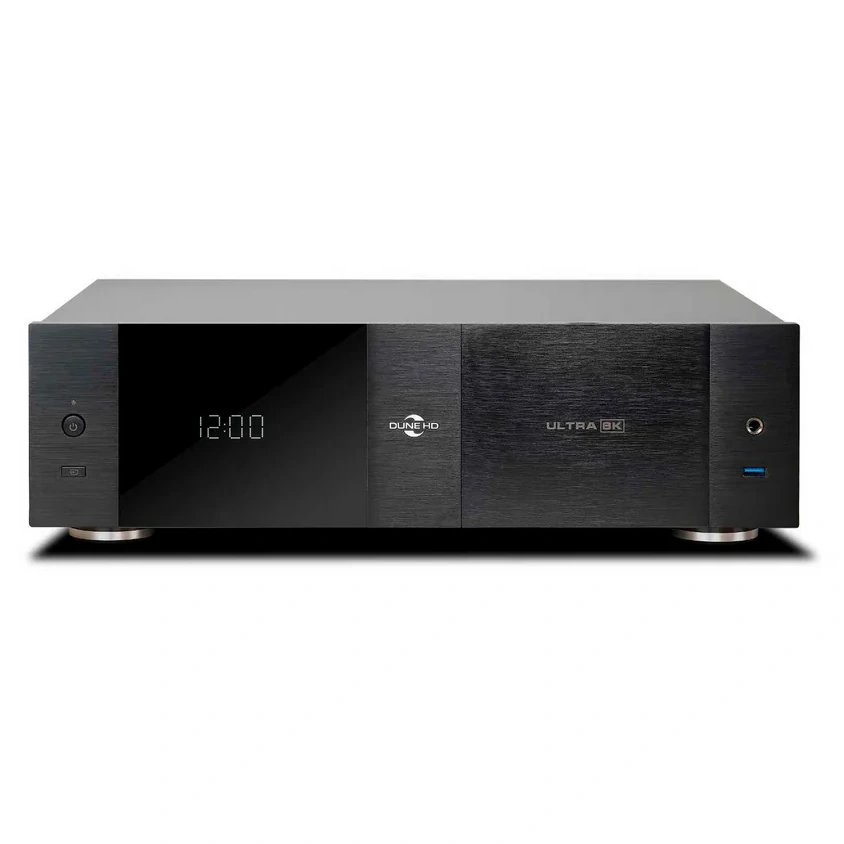
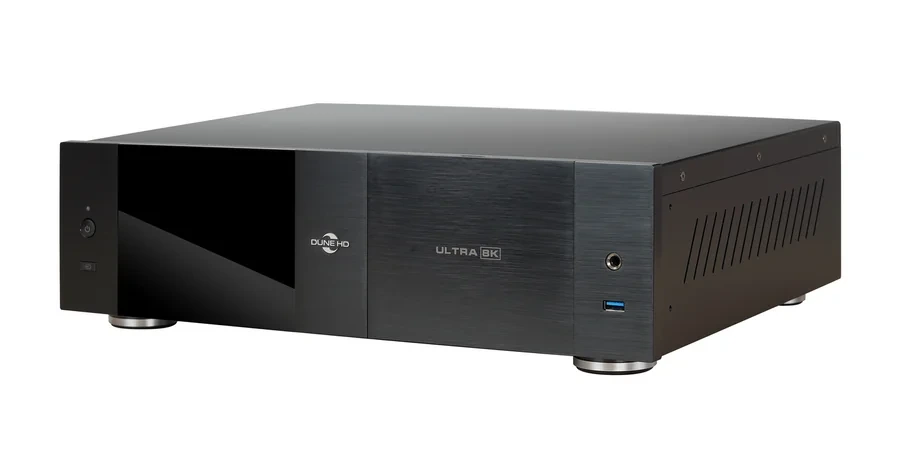
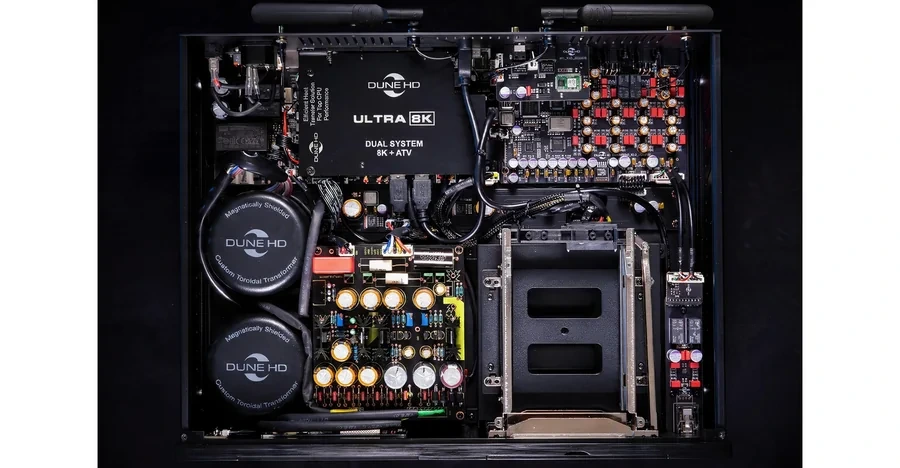
Dune HD Ultra 8K combines a local media playback system with a separate certified Android TV platform. Its full-width aluminium enclosure houses two ESS ES9038PRO DACs, independent linear power supplies and two hot-swap 3.5-inch drive bays.
Key features
Two independent playback systems: The main S928X-K/J platform handles local 8K video and music. A separate S905X4-K module runs certified Android TV streaming. Both appear in the same menu and use shared outputs and a common remote.
Certified streaming: The Android TV system is certified by Google and Netflix, with streaming up to 4K Dolby Vision and Dolby Atmos. Services include Netflix, Prime Video, Disney+, Apple TV+ and YouTube; availability depends on the region and service.
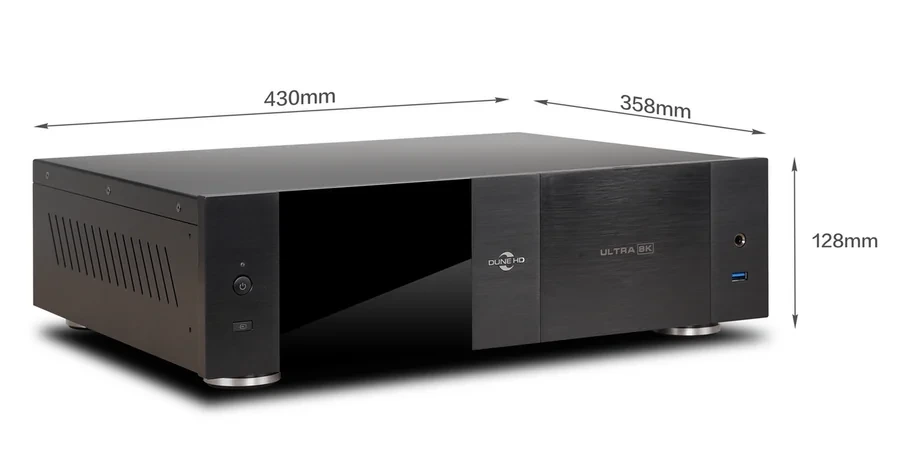
Full-width aluminium construction: The 430 mm-wide all-aluminium enclosure has a brushed front, 128 mm height and space for the separate power and audio circuits. The enclosure also dissipates processor heat.
Separate linear power circuits: Two independent, shielded toroidal transformers feed the digital system and the DAC/analogue section separately. Linear regulation and low-noise supplies reduce interference between these circuits.
TCXO reference clock: A temperature-compensated oscillator supplies a stable timing reference to the main processor and digital A/V circuits. Its dedicated low-noise supply is intended to limit timing noise and jitter.
Dual-mono ESS DAC: Two ES9038PRO chips serve the left and right channels separately, with eight DAC channels in parallel per stereo channel. Main-system playback supports stereo PCM up to 768 kHz and native DSD512.
XMOS XU-316 and clock modes: The audio processor provides bit-perfect transfer and reclocking. Separate 45.1584 MHz and 49.152 MHz references cover the 44.1 kHz and 48 kHz families. Setup offers ASYNC or shared-clock SYNC operation.
Isolated audio circuitry: Power, signal and control lines of the DAC are galvanically isolated. Each DAC and the left/right op-amp circuits have dedicated low-noise regulation. The analogue path uses 0.1% resistors without coupling capacitors, Panasonic OS-CON SEPF and Nichicon MUSE Fine Gold capacitors, plus a chassis ground terminal.
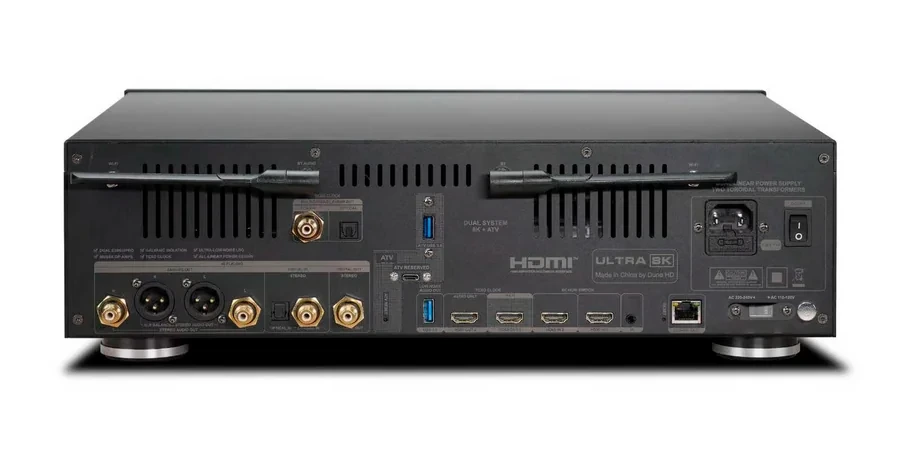
RCA and balanced XLR: MUSES02 and AD826 op-amps drive the analogue outputs. XLR is fully differential. Selectable levels allow matching to an amplifier, preamplifier or active speakers; exact voltage settings are listed below.
Headphone listening: An OPA1622 amplifier drives the front 6.35 mm socket. The internal DAC connection is balanced, with selectable output levels and support for headphones up to 600 ohms.
DAC inputs: The internal DAC accepts the main system, Android TV, HDMI inputs, optical/coaxial S/PDIF and Bluetooth. Stereo PCM from HDMI and S/PDIF inputs is supported up to 192 kHz.
Bluetooth audio reception: Receive music from a phone, tablet or other Bluetooth source using codecs including LDAC and aptX HD. Route it to the internal DAC and RCA/XLR/headphones, or to HDMI and the basic S/PDIF outputs.
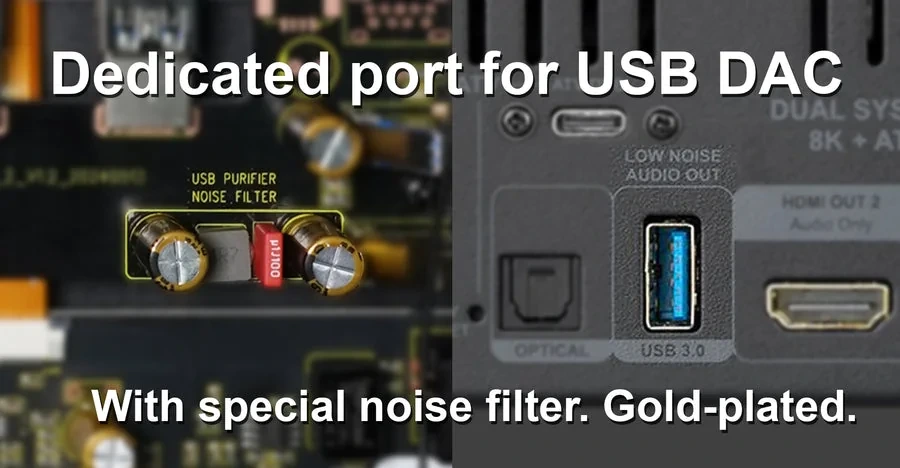
Digital audio connections: The dedicated Hi-Fi coaxial output is driven by XMOS and supports stereo PCM to 192 kHz. A filtered, gold-plated USB port connects an external USB DAC to the main system with reduced electrical noise transfer.
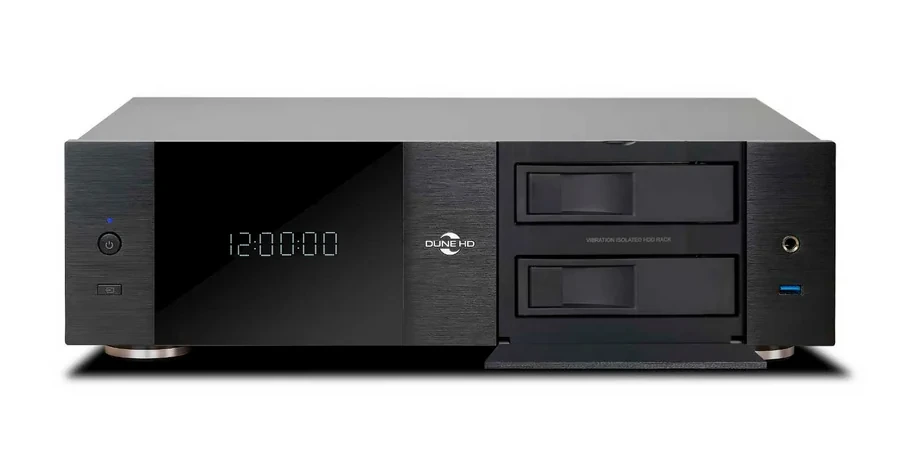
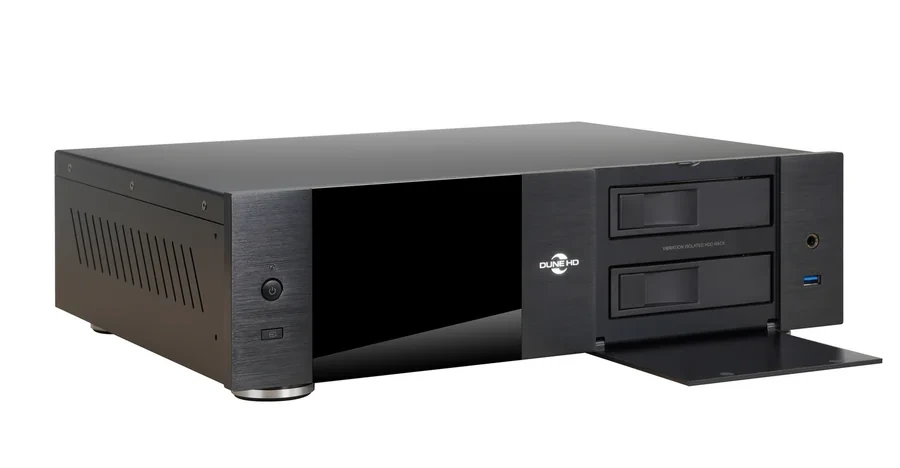
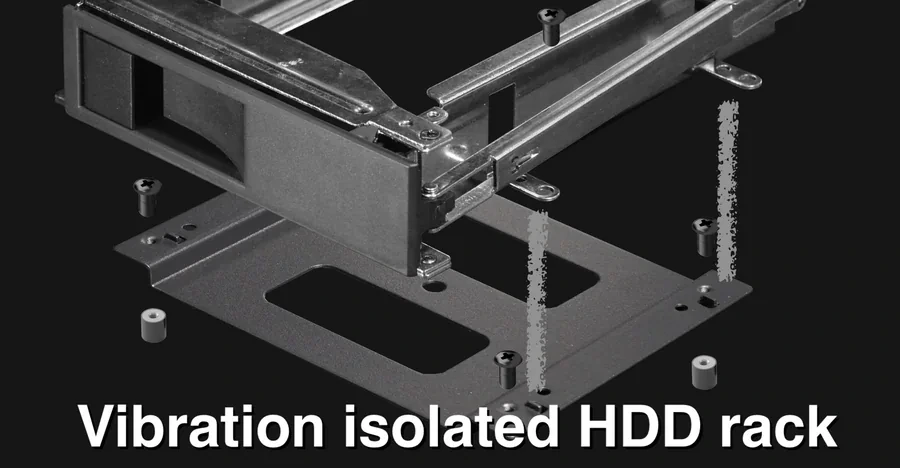
Two hot-swap drive bays: Install two 3.5-inch SATA drives, each rated for 32 TB or more, for 64 TB or more combined. Tool-free trays use vibration isolation. Network access is available through SMB; 2.5-inch drives require separate adapters.
Separate HDMI video and audio: HDMI1 carries video and audio while HDMI2 is dedicated to audio. This allows a newer display to receive video directly while an older compatible receiver receives the audio signal.
HDMI inputs and extraction: Two inputs accept 8Kp60 HDR, 4Kp60 Dolby Vision or 4Kp120, HD audio through DTS:X and HDCP 2.3. Pass video/audio to HDMI1 and extract sound to HDMI2, S/PDIF or the analogue DAC outputs; DAC extraction uses stereo PCM.
Integrated HDMI switching: The built-in 8K switching/audio-extraction engine uses the hardware platform referenced by the manufacturer for the HDFury 8K VRROOM. It combines HDMI switching and audio splitting inside the player.
S928X video platform: The main system supports 8K, AV1, Dolby Vision VS10, HD audio, Dolby Vision files and disc-image menus. Compared with RTD1619DR models, BD3D is not retained; supported 3D modes are listed in Video.
8K processing and AV1: Decode and output video at up to 8Kp60 HDR, downscale to lower resolutions or upscale to 8K. YouTube 8K HDR and AV1 decoding are supported. AV1 can reduce streaming bandwidth for a given quality.
Processor and graphics: The main CPU combines four 2.0 GHz Cortex-A55 cores, a 1.9 GHz Cortex-A76 core and a system core, with Mali-G57 graphics, LPDDR4X and eMMC. The maker reports performance up to twice RTD1619DR and an Antutu result above 300,000. Android TV has its own quad-core Cortex-A55 processor.
Memory divided between systems: The 12 GB RAM total is split into 8 GB for the main system and 4 GB for Android TV. Built-in flash totals 96 GB: 64 GB main-system storage plus 32 GB for Android TV. The independently allocated memory keeps streaming workloads separate.
HDR and VS10: Dolby Vision and HDR10+ provide dynamic HDR metadata. VS10 handles conversion among SDR, HDR and Dolby Vision, including use with displays or projectors that do not support every input format.
Dolby Vision on HDR projectors: The LLDV-HDR mode performs Dolby Vision processing for compatible HDR projectors without native Dolby Vision. The source also describes advanced Dolby Vision tuning in this context; results depend on projector and setup.
Dolby Vision files and disc images: Profiles 5, 7 MEL/FEL and 8 are supported in MKV, MP4, TS/M2TS, ISO and folder structures. Profile 7 playback uses the base-layer video and enhancement-layer RPU information, with 10-bit video output. Both MEL and FEL disc structures are supported.
HD audio and original sample rates: Pass Dolby/DTS formats through HDMI, including TrueHD Atmos and DTS:X, or decode to PCM up to 7.1. HDMI and S/PDIF preserve PCM rates from 44.1–192 kHz; the built-in/USB DAC paths support stereo PCM to 768 kHz and native DSD512.
Music libraries and SACD: Play multichannel FLAC, WavPack, APE, ALAC and SACD images/files in ISO, DFF or DSF, including DST. Multichannel DSD can be converted to multichannel HDMI PCM; stereo DSD can also be delivered as PCM over HDMI/S/PDIF.
Disc images, CUE and gapless audio: External and embedded CUE sheets are supported for audio-disc images and music files. Gapless playback keeps continuous recordings and albums free of track-change pauses.
Network audio and player display: Use the player as a DLNA renderer for music sent from a phone, computer or server, including bit-perfect transfer through its Hi-Fi path. The audio UI offers alternate information views, backgrounds and a spectrum display, with Dune Control integration.
Apps on either system: Choose the main Android 11 AOSP platform for hardware flexibility, or the separately certified Android TV 14 platform for supported streaming services. Both integrate into the main user interface.
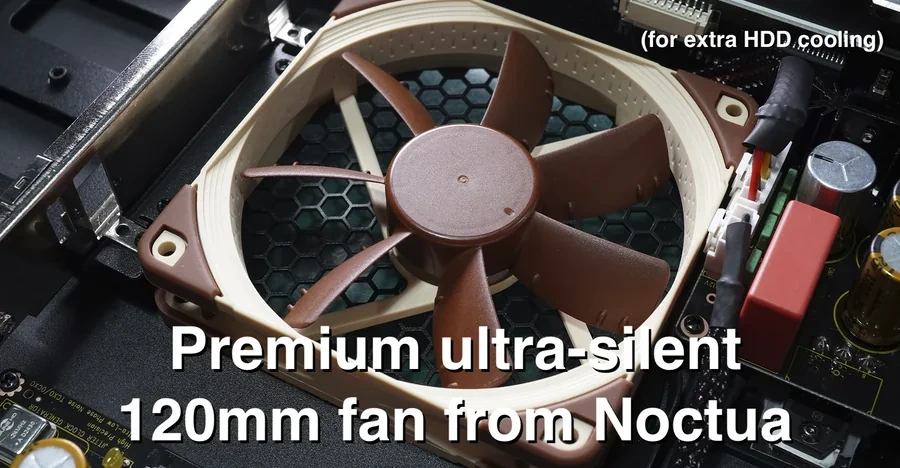
Drive noise and cooling: Damped trays separate drive vibration from the enclosure. The aluminium case acts as a passive heatsink, assisted by a 120 mm Noctua fan for additional drive cooling.
Disc menus and playback sources: Play ISO images and movie folders from USB/SATA drives or SMB/NFS shares with menus, 4K, Dolby Vision, HDR10/HDR10+ and HD audio, subject to the format and application capabilities.
Frame-rate and resolution matching: Output modes can follow the source manually or automatically. Switching before playback begins limits visible mode-change flicker and lets the player or display perform scaling.
Widevine and operating system: Widevine L1 is supported. The main system combines Linux-based Dune HD software and Android running together. Its Android configuration avoids unnecessary drive folders/indexing, while Playback Accelerator manages competing workloads.
Applications and integration: The Dune HD SDK/APIs support plugins, skins, jukeboxes, collection tools and home-automation integrations. IP control connects compatible smart-home systems, and the firmware shares the long-running Dune HD software platform.
Collection browsing and mobile control: My Collection organises films/series with posters, descriptions, trailers and related titles. The file browser recognises movies. Dune Control on iOS/Android mirrors navigation, browses media and provides Now Playing controls.
Network and accessories: Gigabit Ethernet and dual-band 2T2R Wi-Fi 6 connect network libraries. Bluetooth 5.2 supports compatible remotes, keyboards, mice, controllers and audio devices.
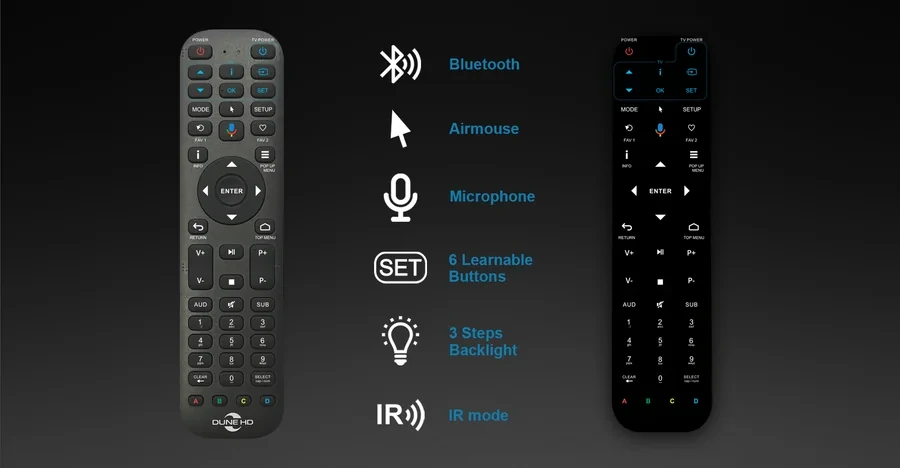
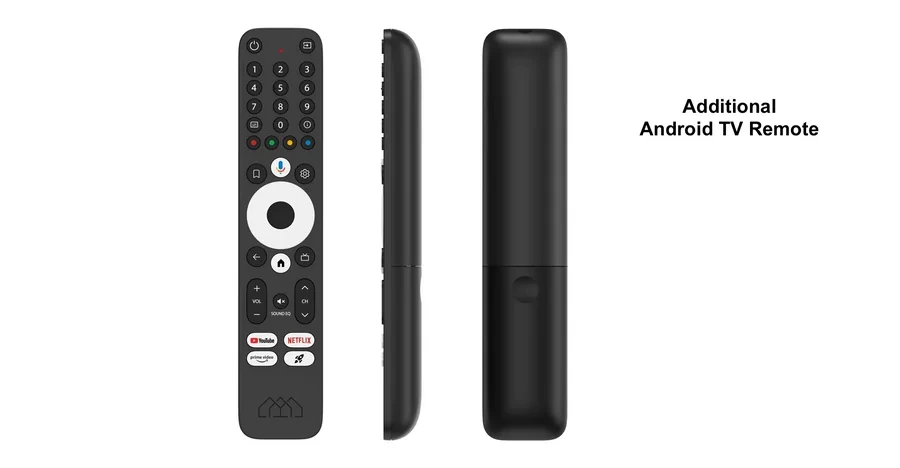
Two supplied remotes: The R4 remote includes microphone, Air Mouse, IR learning, selectable three-level/off backlight and IR/Bluetooth modes. The extra Android TV remote handles initial setup, voice search and IR control of compatible TV/receiver equipment.
IR and front display: The built-in IR receiver also accepts compatible programmable remotes and IR-based automation. The front display can show playback time or a clock and indicators for system, HDMI input and audio source.
Specifications
Hardware
Media processor: Amlogic S928X-K/J (main system), Amlogic S905X4-K (Android TV)
Operating memory: Total 12 GB (8 GB – main system, 4 GB – Android TV)
Flash memory: Total 96 GB (64 GB – main system, 32 GB – Android TV)
Ethernet: 10/100/1000 Mbit/s
Wi-Fi: 802.11b/g/n/ac/ax (Wi-Fi 6), Dual Band 2.4+5 GHz, 2T2R
Bluetooth: 5.2
USB ports: 2x USB 3.0 host (main system), 1x USB 3.0 ATV port (Android TV, for service and special needs)
Built-in HDD racks: 2x 3.5″ SATA HDD, each HDD up to 32 TB and more, hot swap, vibration isolation
HDMI1 output: Main output (video + audio), HDMI 2.1a up to 8Kp60 HDR / 4Kp60 Dolby Vision, experimental support for 120 Hz (up to 4Kp120), full support for all formats of HD audio (up to Dolby TrueHD and DTS:X)
HDMI2 output: Audio-only output, HDMI 1.4, full support for all formats of HD audio (up to Dolby TrueHD and DTS:X)
HDMI inputs: 2x HDMI inputs, HDMI 2.1a up to 8Kp60 HDR / 4Kp60 Dolby Vision / 120 Hz (up to 4Kp120), full support for all formats of HD audio (up to Dolby TrueHD and DTS:X), HDCP 2.3, video + audio passthrough to HDMI1 output, audio extraction to HDMI2 output, audio extraction to S/PDIF and analog audio output
Coaxial S/PDIF audio output: Basic digital audio output (from the main system, Android TV system, HDMI inputs, Bluetooth); supports stereo PCM up to 192/24 and compressed multichannel audio formats (Dolby Digital, DTS)
Optical S/PDIF audio output: Basic digital audio output (from the main system, Android TV system, HDMI inputs, Bluetooth); supports stereo PCM up to 192/24 and compressed multichannel audio formats (Dolby Digital, DTS)
USB audio output: One of the USB ports is optimized for connecting an external USB DAC (includes advanced noise filtering to minimize noise transfer from the media player to the external DAC) (supports audio output from the main system)
Front panel display: Multi-segment LED display HH:MM:SS; additional indicators for system status, active input source (media player / HDMI IN 1 / HDMI IN 2), active system (main system / Android TV), active audio input (optical / coaxial / Bluetooth)
Front panel power button: Yes
Front panel input selection button: Yes, selects the active input source (media player, HDMI IN 1, HDMI IN 2)
IR receiver: Built-in IR receiver, supports Dune HD IR codes and Google IR codes
IR input port: For connecting external IR receiver (included); 3.5 mm minijack, T-R-S: 5V-IR-GND, L=14.5 mm ( → details )
Antennas: 2x external Wi-Fi antennas (detachable) + 2x external BT antennas (non-detachable)
Remote: Bluetooth remote with microphone (voice search), Air Mouse, IR learning, backlight, IR mode
Case: Full-sized (43 cm), all-aluminum, brushed aluminum front panel
Cooling: Passive (entire case as a super-efficient heatsink) and active (120 mm premium ultra-silent fan from Noctua for extra HDD cooling)
Dedicated chassis ground connector: Yes
Built-in power supply: Power supply with two shielded toroidal transformers and linear regulation; the transformers are fully independent: one powers the main digital system, the other powers the DAC section
Power input: AC ~220-240/110-120V, 50/60Hz
Dimensions (W x H x D): 430 mm x 128 mm x 358 mm
DAC
Built-in DAC: 2x ESS ES9038PRO (dual mono)
Op-amps: MUSES02 + AD826 (for RCA and XLR outputs), OPA1622 (for headphones)
DAC sources: Main system, Android TV system, HDMI inputs (stereo PCM), S/PDIF inputs (stereo PCM), Bluetooth audio input
DAC audio formats: Stereo PCM up to 768 kHz, native DSD up to DSD512 (when playing audio on the main system)
Hi-Fi coaxial S/PDIF input: Stereo PCM up to 192 kHz; audio output to the built-in DAC
Hi-Fi optical S/PDIF input: Stereo PCM up to 192 kHz; audio output to the built-in DAC
Bluetooth audio input: Supports audio streaming from mobile devices and other Bluetooth sources; supports advanced audio codecs such as LDAC and aptX HD; supports audio output to the built-in DAC; additionally supports audio output to the basic coaxial and optical S/PDIF outputs and to HDMI
Hi-Fi RCA analog stereo audio output: Audio output from the built-in DAC; 2.0/1.0/0.5/0.25 Vrms
Hi-Fi XLR balanced analog stereo audio output: Audio output from the built-in DAC; 4.0/2.0/1.0/0.5 Vrms
Hi-Fi 6.35 mm headphone audio output: Audio output from the built-in DAC; 2.0/1.0/0.5/0.25 Vrms; up to 600 Ohm
Hi-Fi coaxial S/PDIF audio output: Audio output from XMOS; stereo PCM up to 192 kHz
XMOS audio processor: XMOS XU-316; audio output from the main system only; audio transmission to the built-in DAC and Hi-Fi S/PDIF; reclocking
Clock generators: Separate dedicated high-precision clock generators for sample rates based on 44.1 and 48 kHz (45.1584 MHz for 44.1 kHz and 49.152 MHz for 48 kHz)
DAC clocking modes: Standard ASYNC mode, advanced SYNC mode (can be chosen in setup menu)
DAC galvanic isolation: Full galvanic isolation of the DAC from other parts of the media player (including power, data and control lines)
DAC analog path: No coupling capacitors in the signal path; low-noise resistors with 0.1% tolerance are used
DAC power: Dedicated toroidal transformer; fully linear power with multi-stage ultra-low-noise LDOs; a separate group of linear ultra-low-noise regulators is used for each ES9038PRO chip; separate ultra-low-noise linear regulators are installed for the operational amplifiers of the right and left channels; Panasonic OS-CON SEPF polymer capacitors are used in the regulator circuits of the digital section, and Nichicon MUSE Fine Gold audiophile capacitors are used in the analog path power supply
Video
8K video decoding: Yes, up to 8Kp60 HDR; 8K content can be downscaled to 4K, 1080p or lower output resolution
8K video output: Yes, up to 8Kp60 HDR; any content can be upscaled to 8K output resolution
Video decoding: AV1, VP9 profile 2, H.265 (HEVC), H.264 (AVC), VC1, MPEG4, MPEG2, MPEG1
HDR formats: Dolby Vision, HDR10+, HDR10, HLG
Dolby Vision VS10 engine: Yes
Dolby Vision playback: Profiles 5, 7 (MEL and FEL), 8; various containers (ISO, movie folder structure, MKV, MP4, M2TS); DTDL (double-track double-layer), STDL (single-track double-layer), STSL (single-track single-layer). Double-track/double-layer video (profile 7 MEL, profile 7 FEL) is played with the use of data from both tracks/layers: video data from the first track/layer (with 10-bit color depth – the maximum color depth supported by OLED panels in OLED TVs), extended Dolby Vision information (RPU metadata) from the second track/layer
Dolby Vision output: LLDV (Low Latency Dolby Vision / Player-led Dolby Vision), STD DV (Standard Dolby Vision / TV-led Dolby Vision)
Manual preference for LLDV or STD DV: Yes
HDR mode (SDR/HDR/DV) switching: manual and automatic (according to played content)
Framerates: all standard framerates including 23.976, 24.0, 25.0, 29.97, 30.0, 59.94, 60.0; experimental support for 120 Hz output
Framerate and resolution switching: manual and automatic (according to played content)
Video upscaling and downscaling: Yes
3D video support: Side-by-Side, Top-and-Bottom (TV requires manual switching into 3D mode)
Video file formats: MKV, MPEG-TS, MPEG-PS, M2TS, VOB, AVI, MOV, MP4, QT, ASF, WMV, ISO, movie folder structures
BD playback: Lite (direct video playback without menu), Full Menu
DVD-Video playback: Lite (direct video playback without menu) , Full Menu
Audio
Bitstream passthrough: bitstream passthrough of all Dolby/DTS formats (up to Dolby TrueHD Atmos and DTS:X)
Decoding of Dolby/DTS formats: multichannel decoding (up to 7.1 channels) of all Dolby/DTS formats (up to Dolby TrueHD Atmos and DTS:X)
Audio decoding: MPEG-1/2 layer I/II/III, AAC, LPCM, FLAC, multichannel FLAC, Vorbis, WavPack, APE (Monkey’s Audio), ALAC (Apple lossless), SACD DSD (stereo and multichannel) (supports output of decoded multichannel DSD as multichannel PCM to HDMI), multichannel PCM (up to 7.1), all Dolby/DTS formats (up to Dolby TrueHD Atmos and DTS:X)
Audio file formats: MP3, MPA, M4A, AAC, WAV, FLAC, Ogg/Vorbis, WavPack, APE (Monkey’s Audio), ALAC (Apple lossless), SACD ISO (stereo and multichannel), SACD DSF (stereo and multichannel), SACD DFF (stereo and multichannel), AC3, DTS, DTS-WAV
PCM audio output: original sample rate (44.1 to 192 kHz)
Other Features
Subtitle formats: SRT (external), SUB (MicroDVD) (external), text (MKV), SSA/ASS (MKV, external), VobSub (MP4, MKV, external SUB/IDX), PGS (ISO, TS, MKV)
Online subtitles: Automatically download subtitles from the Internet
Picture file formats: JPEG, PNG, BMP
Photo viewer functions: Slideshow, transition effects, picture rotation, zoom, view playlist, repeat, shuffle
Playlist file formats: M3U, PLS, CUE
Playlist functions: Build playlist from selected folders and files, build playlist from selected playlist files, view playlist file, view current playlist, quickly jump to next/previous or selected playlist item, repeat, shuffle, playlist of photo files, playlist of audio files, playlist of video files, mixed playlist of audio and video files
SMB client: Browse SMB servers/shares, manually connect to SMB share, directly access (read-write) and play files (SMB v1/2/3)
NFS client: Browse NFS servers/shares, manually connect to NFS share, directly access (read-write) and play files
SMB server: Share connected storage devices (internal HDD, USB HDD) and internal flash memory to local network via SMB protocol (SMB v1/2/3)
DLNA renderer: Stream audio from smartphones and other devices
iOS and Android mobile apps: Control the media player via the powerful Dune Control mobile app
IP control: Use the built-in IP Control interface to integrate the media player into Smart Home and Home Automation systems
OS and Apps
OS: Linux-based Dune HD software platform + Android 11 AOSP (main system), Android TV 14
OS kernel: 64-bit
Android apps: 32-bit
Support for HDDs larger than 16 TB: Yes
Filesystems: FAT16/FAT32 (read-write), EXT2/EXT3/EXT4 (read-write), NTFS (read-write), exFAT (read-write), HFS/HFS+ (Mac OS Standard/Extended) (read-only), BTRFS (read-write)
Widevine DRM: Widevine L1
Google Android TV certification: Yes (Android TV system)
Netflix certification: Yes (Android TV system)
Functions requiring Internet connection: Some functions may require Internet connection to verify Dune HD license. The set of functions which require Internet connection may change across firmware versions.
In the box
- Media player x1
- Wi-Fi antenna x2
- Bluetooth remote x1
- Additional Android TV remote x1
- Batteries AAA x2
- PC power cord EU plug x1
- PC power cord US plug x1
- PC power cord UK plug x1
- PC power cord AU plug x1
- HDMI cable 8K Ultra High Speed x1
- IR extender x1
- Quick installation guide x1
- 19″ rack mounting brackets x2
- Set of screws for 19″ rack mounting brackets x1
Interface
TV navigation: Remote-friendly Dune HD menus present both systems and their apps in one interface.
SMB/NFS browsing: Open media directly from a computer or NAS over the local network.
My Collection: Organise a personal library of films and television series.
Movie discovery: Browse descriptions, trailers, cast connections and related titles, including movies outside the local collection.
Service shortcuts: Launch a title through a connected streaming service when supported.
Movie recognition: Identify titles and display movie information from the file browser.
File operations: Copy, move, rename, sort, delete and organise files and folders.
Favourites and startup: Bookmark files, folders, films, people and apps, and select a favourite to open on boot.
Recent playback: Return to recently played items and resume viewing.
TV and programme guide: Configured Internet TV channels use the TV browser; available EPG data can link programmes to movie details, trailers and connected services.
Playlists: Build playlists from media selections or open playlist files.
Skins and jukeboxes: Customise the interface and use compatible third-party library applications.
Apps and extensions: Install Dune Store/third-party plugins and Android applications from an app store or APK. The platform supports Dune HD PHP APIs, skins and dune_folder.txt.
Background media: Continue music, radio, TV or video while browsing menus and using compatible Android apps.
Web browser: Install a compatible browser for websites and supported online video.
Compatibility & support
Firmware updates may be needed for some functions. Supported formats and playback behaviour depend on the application, media encoding, connected equipment and system configuration. Compatibility with every file, app or A/V component is not guaranteed. Streaming availability and quality depend on the service, subscription and country. Some functions verify the Dune HD licence over the Internet; requirements may change with firmware.
Product photos are illustrative and hardware or specifications may change. HDFury is a third-party trademark mentioned by the manufacturer for the HDMI hardware-platform comparison.
Official Ultra 8K specifications and latest manufacturer information